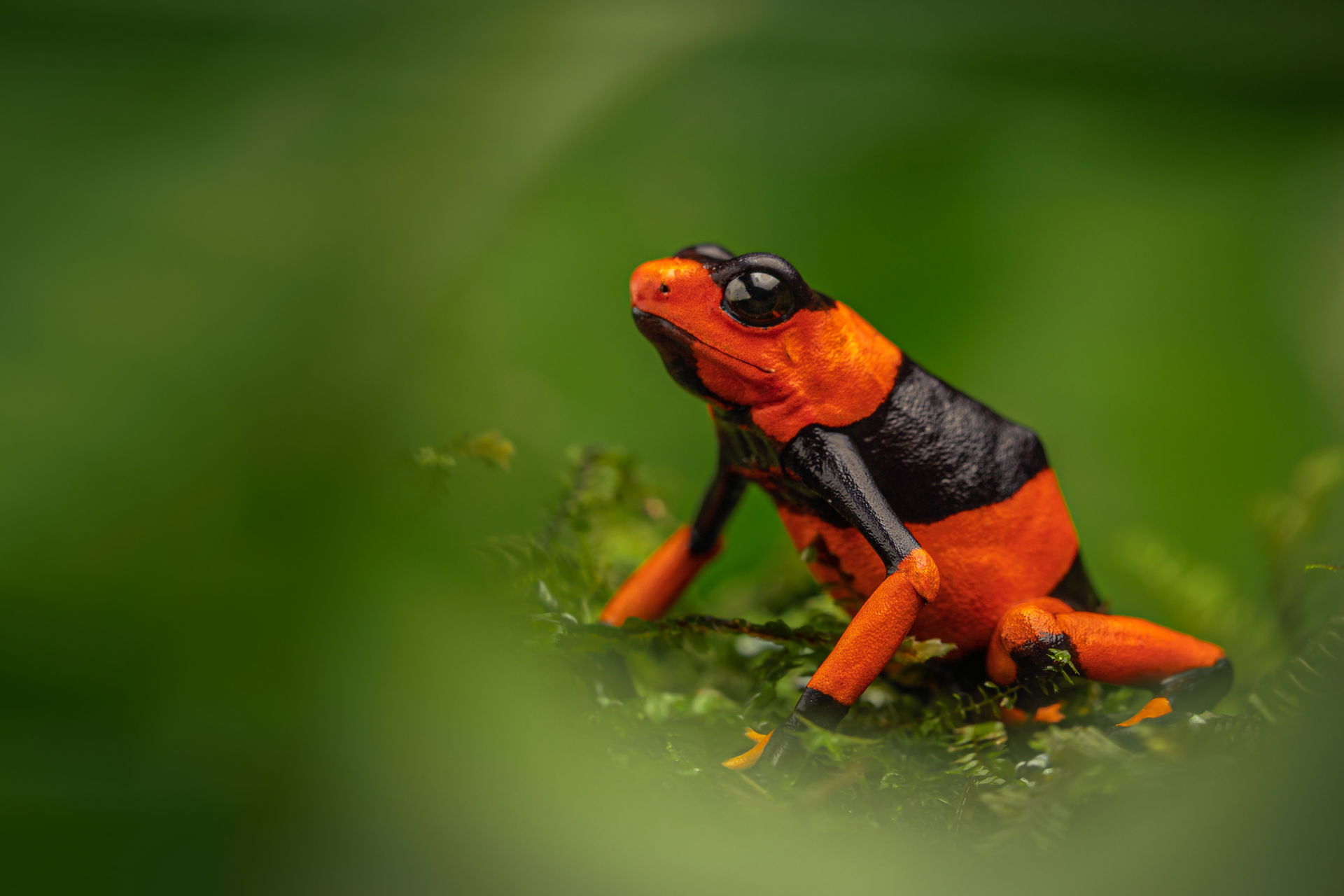
Lehmann's poison frog has a deep black base colour with bright stripes or patches of red, orange or yellow – a typical warning sign of its toxicity. It is endemic to a highly fragmented area on the Pacific coast of Colombia. Its total range covers less than 10 square kilometres.
As with other Oophaga species, Lehmann's poison frog provides intensive brood care: At the end of the rainy season, the male actively calls for mating, guards the fertilised clutch and carries the hatched tadpoles individually to water-filled plant structures such as bromeliad funnels. The female feeds the tadpoles there with unfertilised food eggs at intervals of three to six days. Metamorphosis into the adult form finally takes place after about two to three months.
The Lehmann's poison frog is critically endangered. The main causes are habitat loss, severe habitat fragmentation and illegal capture for the pet trade. At the same time, the labour-intensive brood care practised by this species makes artificial offspring rearing considerably more difficult.
This made the success all the more significant when, in 2023, 29 animals bred in captivity were released into the wild for the first time as part of the Amphibian Survival project supported by Zoo Zurich. The release was carried out in collaboration with Cali Zoo and the Wildlife Conservation Society in an area where the species was originally native but had already become locally extinct.
Taxonomy
Tree-climbing frogs (Dendrobatidae), egg-eating tree-climbing frogs (Oophaga, 9 species)
Habitat
tropical rainforest at altitudes of between 600 and 1,200 metres above sea level
Behaviour and ecology
diurnal, living on the ground or in the lower branches of primary or secondary forests
Diet
small (poisonous) insects and other invertebrates